The climategate emails have sparked scrutiny that has unraveled scandalous misconduct on a monumental scale, and new revelations are still emerging. But the evidence of deceit was mounting even before the thousands of incriminating emails and other electronic files were leaked from the University of East Anglia's Climate Research Unit (CRU).
In August 2009 the CRU admitted it had discarded the raw data used to calculate global surface temperatures, a clear violation of scientific principles and the United Kingdom's Freedom of Information Act. One never discards data; it is essential to the scientific process that scientific claims can be replicated and verified by others. What was in that data that made researchers so eager to prevent others from finding it that they would even violate the law? If their conclusions about global warming were valid, wouldn't they have wanted others to verify and support them?
At the 2009 annual meeting of the Geological Society of America, Dr. Don Easterbrook demonstrated how tree ring data from Russia showing cooling after 1961 were truncated and artfully disguised in the IPCC's latest Assessment Report (AR4). A graph courtesy of JoNova.com shows this deception:
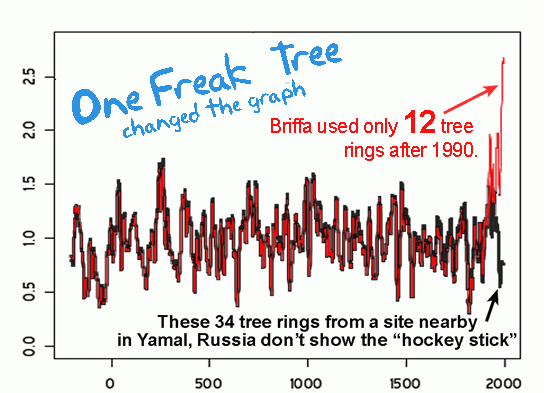
Fig. 1
That same report also claimed that Himalayan glaciers will have melted by 2035. The IPCC's rules require that all assertions in its assessment reports be based on published papers in refereed journals. But the IPCC lists the source here as the World Wildlife Fund, an environmental advocacy organization with no refereed journal but a well deserved reputation for exaggerated claims. The WWF is cited as a source for fifteen other assertions in AR4. The WWF reference to the Himalayan glaciers melting was based on speculation—not research—in a comment during a magazine interview via telephone with a little-known Indian scientist Syed Hasnain in 1999. He now says he was misquoted by WWF. Professor Georg Kaser, a leading glaciologist, says of the 2035 forecast, “This number is not just a little bit wrong, but far out of any order of magnitude. It is so wrong it is not even worth discussing.” The IPCC said the 2035 number was a typographical error. But Dr. Murari Lal, who was the coordinating lead author of the IPCC report's chapter on Asia, says he knew Hasnain's statement lacked scientific verification but included it anyway to encourage politicians to act, thereby demonstrating more concern with political activism than scientific accuracy. India's environment minister, Jairam Ramesh, said the glacial melting claim “was clearly out of place and didn't have any scientific basis.” And he said the Indian government has established its own body to monitor the effects of global warming because it “cannot rely” on the United Nation's IPCC, which is headed by India's leading scientist Dr. R.K. Pachauri. Pachauri remained silent about the Himalayan glaciers even when he knew the information was false. He said he was unaware the information was false before the Copenhagen summit, but the Washington Times cites evidence from email correspondence that he knew of the fraud earlier. In January 2010 the IPCC withdrew its assertion about the glaciers melting.
Incidentally, Hasnain now works for the Energy Research Institute, which is headed by Dr. Pachauri. According to the Times of London, that institute has collected millions in grant money to study the effects of glacial melting. The scientist at the root of the bogus claim now runs the unit that got the money. The donors include the European Union, Deutsche Bank, Toyota, and Yale University. Pachauri is now a director or advisor to scores of banks, investment institutions and carbon traders, many presumably hoping to benefit from his inside knowledge of IPCC policies.
Then there is the IPCC's assertion that climate change could endanger up to 40 percent of the Amazon rainforest. For this, the IPCC relied on a report written for WWF and another environmental advocacy group by an activist and a journalist, P.F. Moore and Andy Rowell, who claimed it was based on an article in the scientific journal Nature. But that article wasn't about global warming at all but about the effects of logging, as the title of the article by D.C. Nepstad et al states: "Large-scale Impoverishment of Amazonian Forests by Logging and Fire," (Nature, vol. 398, no. 8. April, 1999.) Dr. E. Calvin Beisner explains, in the Cornall Alliance Newsletter January 29, 2010:
"'Logging companies in Amazonia kill or damage 10-40% of the living biomass of forests through the harvest process,' the article says. 'Logging also increases forest flammability by reducing forest leaf canopy coverage by 14-50%, allowing sunlight to penetrate to the forest floor, where it dries out the organic debris created by the logging.'
"But on further examination, it turns out that Nepstad, et al., don't apply their '10-40% of the living biomass' to the Amazon rainforest as a whole but to those particular parts of it that are affected by logging—and those parts don't amount to anything near 40%. They amount to, at most, 630,000 square kilometers out of the 4 to 6 million square kilometers of rainforest—i.e., 10-15%. And what Nepstad, et al, claim is that 'Logging companies' (not global warming) 'in Amazonia kill or damage 10-40% of the living biomass of' those parts of the rainforest. In other words, they may 'kill or damage 10-40%' of 10-15%, which means anything from 1-6% of the total Amazon rainforest.
"In short, Moore and Rowell, in their non-peer-reviewed advocacy piece written for and published by two advocacy organizations, substituted global warming for logging companies as the cause of the damage and inflated 1-6% to 10-40% as the extent of the damage. And then the IPCC, violating its standard of citing only peer-reviewed literature to substantiate its claims and failing even to check the accuracy of the non-peer-reviewed source, warned the world that 'Up to 40%' (the upper end of the spectrum) 'of the Amazonian forests could . . . be replaced by . . . tropical savannahs' because of global warming.'"
The IPCC claimed that one-fifth of Bangladesh will be under water by 2050. But according to 30 years of satellite imagery by the Centre for Environmental and Geographical Information Services in Dhaka, the nation's surface area appears to be growing by 20 square kilometers per year.
The AR4 report links climate change to coral reef degradation. The sole source the IPCC cites for this claim is a Greenpeace report entitled “Pacific in Peril.”
The IPCC has also cited a study by British climatologist Nigel Arnell claiming that global warming could deplete water resources for as many as 4.5 billion people by 2085. It neglected to mention his finding that global warming could increase water resources for as many as six billion people.
The IPCC has relied on WWF studies regarding “transformation of natural coastal areas”, “destruction of more mangroves”, “glacial lake outbursts causing mudflows and avalanches”, and changes in the ecosystem of the “Mesoamerican reef.” Other noteworthy sources cited by the IPCC include a mountaineering magazine and a student paper. Not the sort of thing you would expect from a Nobel Prize-winning report, from the organization that is proclaimed to be the definitive word on climate science. And hardly “as solid as careful science can make it.”
The above examples show that the IPCC is an agency of political activisim, not science, but they do not show the far larger and more serious corruption. Temperature records throughout the world have been falsified by dropping reporting stations. Beginning about 1990, higher-altitude, higher-latitude, and rural stations were removed from the network in order to create a false warming trend. The global temperature record that used to be based on 6,000 reporting stations now is based on fewer than 1,500. A stunning 106-page report by two veteran meteorologists, Joseph D'Aleo and Anthony Watts, and recently published by the Science and Public Policy Institute documents the effect with this graph:

Fig. 2
Rise in global temperature correlates with eliminating
data from weather stations likely to show cooling,
In many cases the stations are still reporting, but their data are no longer utilized. Often the stations have been replaced by others more likely to show warming from lower elevations, lower latitudes, or urban development, which reflects the well-known “heat island” effect of cities. Data gaps are filled in by extrapolating from nearby stations.
Here's an example from the SPPI report:
"Throughout South America the higher elevation stations disappeared, while the number of coastal stations increased. The 50 percent decline in stations and changing distributions may help to explain some of the warming since 1990....Take for example Bolivia. There has not been any thermometer data for Bolivia in [the data base] since 1990. Monthly and annual anomaly charts show warmth over Bolivia. How does NOAA [National Oceanic and Atmospheric Administration] and NASA find heat in Bolivia when there is NO data for the last 20 years? They 'make it up' from 'nearby' thermometers up to 1200 km away. So what is within 1200 km of Bolivia? The beaches of Chile, Peru and the Amazon jungle."
Russia and Canada are the two largest countries in the world. Russia alone accounts for 11.5 percent of the globe's land surface area. Surely the climate there must be important to an accurate calculation of a global climate trend, but the SPPI report states:
"In the cold countries of Russia and Canada, the rural stations in the Polar Regions were thinned out leaving behind the lower latitude more urban stations. The data from the remaining cities were used to estimate the temperatures to the north. As a result the computed new averages were higher than the averages when the cold stations were part of the monthly/yearly assessment.
"In Canada, the number of stations dropped from 600 to less than 50. The percentage of stations in the lower elevations (below 300 feet) tripled and those at the higher elevations above 3,000 feet were reduced by half. [The] depicted warmth comes from interpolating from more southerly locations to fill northerly vacant grid boxes, even as a simple average of the available stations shows an apparent cooling."
Environment Canada reports that there are 1400 weather stations in Canada, many reporting even hourly readings that are readily available on the internet but not included in the global data base. Canada has 100 stations north of the Arctic Circle, but NOAA uses just one. And that's in Eureka on Ellesmere Island, which has been called the “Garden Spot of the Arctic” because its summer warmth makes flora and fauna more abundant there than anywhere else in the High Arctic.
The Moscow-based Institute of Economic Analysis (IEA) claims the Hadley Center has tampered with the Russian data. (The Hadley Center for Climate Change of the British Meteorological Office collaborates with the University of East Anglia's CRU in reporting global temperatures.) The Ria Novosti agency reports:
"The IEA believes the Russian meteorological station data did not substantiate the anthropogenic global-warming theory. Analysts say Russian meteorological stations cover most of the country's territory and that the Hadley Center had used data submitted by only 25 percent of such stations in its reports. The Russian station count dropped from 476 to 121 so over 40 percent of Russian territory was not included in global temperature calculations for some other reasons than the lack of meteorological stations and observations."
The Russians found that the 121 sites used gave mostly warmer reports than the 355 unused sites. In some cases stations records going back into the 19th Century were ignored in favor of stations with less data but which pointed to warming. The IEA team stated, “Only one tenth of meteorological sites with complete temperature series are used.” It illustrates with this example:
"Weather station Uchur has a long and almost continuous series of meteorological observations from 1940; the station Toko—an intermittent series of observations from 1946 and continuous only since 1957; however, the trend towards warming in the 20th Century was more pronounced according to station Toko. In the calculations of global temperature, HadCRUT predictably uses the data solely from the station Toko."
In another example, the IEA team found the temperature data series for the station Sortavala had been grossly reduced. The Russian experts tried to reproduce these results but couldn't. Instead they found temperatures consistently lower 0.6 degrees C. If applied to the entire spectrum of world temperature datasets, an error this size would equal the total warming effect of the past century claimed by the IPCC and Al Gore. John O'Sullivan writes, “Many of the so-called peer-reviewed papers allegedly supporting global warming are based on the Russian dataset that has the highest trend of the major ground datasets.”
In Europe higher mountain stations were dropped and thermometers were marched toward the Mediterranean, lower elevations, and more cities. The station dropout was almost 65 percent for Europe as a whole and 50 percent for the Nordic countries.
Africa is not showing warming despite efforts to make it appear so by eliminating thermometers from cool areas like the Moroccan coast and moving them toward the Sahara.
Analyst E. Michael Smith found that most of the stations remaining in the United States are at airports. Most mountain stations of the west are gone. In California the only remaining stations are in San Francisco, Santa Maria, Los Angeles and San Diego.
As recently as 1988 China had over 400 stations. In 1990, only 35. In a 1990 paper the CRU's Phil Jones et al claimed that temperature stations in China “were selected on the basis of station history: we chose those with few, if any, changes in instrumentation, location or observation times." Pressed by critic Doug Keenan for more information on the 84 stations used, Jones at first refused but eventually relented and gave what he had, revealing that he had no information on 49 stations. For these, a joint report of the U.S. Department of Energy and the Chinese Academy of Sciences says station histories were not available and “details regarding instrumentation, collection methods, changes in station location or observing times … are not known.” Keenan accepts that Jones may not have known this in 1990 but states that a paper Jones published in 2001 indicates an awareness by then of serious problems in the Chinese data. Yet Jones continued to rely on his 1990 research, including allowing it to be cited in the 2007 IPPC AR4 report, where it was very influential.
The raw temperature data show no trend in temperatures in Northern Australia in 125 years. The IPCC, however, uses “adjusted” data. NOAA makes data “adjustments” to remove “inhomogeneities” and for other reasons. The SPPI report says, “We have five different records covering Darwin from 1941 on. They all agree almost exactly. Why adjust them at all? NOAA added a huge, artificial, imaginary trend to the most recent half of the raw data.” The raw temperatures in Darwin were falling at 0.7 C. per century. After the NOAA adjustment, the temperatures were rising 1.2 C per century.
In New Zealand, temperatures have been remarkably stable for a century and a half, though the IPCC and others allege warming has been occurring for over 100 years. But New Zealand itself made adjustments to the NOAA climate data. In the SPPI report, D'Aleo and Watts state: “We were astonished to find that strong adjustments have indeed been made.... The shocking truth is that the oldest readings have been cranked way down and later readings artificially lifted to give a false impression of warming....There is nothing in the station histories to warrant these adjustments.” The New Zealand National Institute of Water and Atmospheric Research, which made those adjustments, says it no longer has any record of why or when its adjustments were made.
Changes have been made in the data elsewhere for other reasons. Some changes have been made to mask temperature trends that could readily be explained by natural factors such as ocean circulation patterns and solar cycles. Also, as D'Aleo and Watts, note, “The very same stations that have been deleted from the world climate network were retained for computing the average-temperature base periods, further increasing the bias towards overstatement of warming by NOAA.” NASA is always tampering with its data. John Goetz has shown that it “adjusted” 20 percent of its data sixteen times in two and a half years.
NASA applies an “urbanization adjustment,” but Steve McIntyre reveals that NASA made the adjustment in the wrong direction, exaggerating the warming effect instead of showing what the temperatures would be without urban development. Hadley/CRU makes no adjustment for urbanization. The 1990 paper by Hadley's Phil Jones mentioned above concluded that the urban effect was very tiny and of no serious consequence—based on highly questionable Chinese data. Ross McKittrick and Patrick Michaels, however, showed that accurately correcting for the urban effect would reduce the estimated 1980 - 2002 global temperature trend over land by about half.
The University of East Anglia climategate emails have focused attention on Hadley/CRU, but it and NASA both depend on data supplied by ground stations via NOAA. The SPPI report states “all the data centers, most notably NOAA and NASA, conspired in the manipulation of global temperature records.”
The EPA statement in the Federal Register December 9, 2009, “Warming of the climate system is unequivocal” was followed by “The global surface temperature record relies on three major global temperature datasets, developed by NOAA, NASA, and the United Kingdom's Hadley Center. All three show an unambiguous warming trend over the last 100 years.” The EPA intent obviously was to try to downplay the effect of any Hadley/CRU data manipulation by showing the end result was validated by the other two agencies. But since the three agencies all depend on the same NOAA data, their unambiguous agreement demonstrates not validity but their common corruption.
One of the climategate emails seems to confirm the complicity of NASA and CRU. In an email sent by Michael Mann to Phil Jones of CRU and Gavin Schmidt of NASA, Mann said, “As we all know, this isn’t about truth at all, it’s about plausibly deniable accusations.” This is the same Michael Mann who showed little respect for the truth when he was the lead author of a study that produced the infamous “hockey stick” graph. It showed a thousand years of “reconstructed” global temperatures as a long horizontal trend looking like the long handle of a hockey stick — with a sharp rise since 1900 looking like the blade of the hockey stick, due to global warming. The IPCC so loved this graph that it reproduced it in full color six times in its Third Assessment Report—even showing it twice on one page! But Mann's “hockey stick” has been thoroughly discredited. It was the product of multiple inaccuracies from errors, omissions, obsolete data, and manipulations in “reconstructing” data, all of which was then processed through an invalid statistical procedure. That procedure was found to produce a “hockey stick” even from random inputs, and Mann himself later admitted it would find a “hockey stick” where there wasn't one. The National Academy of Sciences found a “validation skill not significantly different from zero.” The issue was presented to the National Academy of Sciences by the Wegman Panel, consisting of three independent statisticians chaired by an eminent statistics professor, Edward Wegman, who also testified about it at a Congressional investigation. After explaining the incorrect mathematics in Mann’s procedure, Wegman stated: “I am baffled by the [Mann] claim that incorrect mathematics doesn’t matter because the answer is correct anyway[!]” So much for Mann's dedication to science and truth.
Nevertheless, Mann's views have been popular with a U.S. government dedicated to the global warming cause. Last June the National Science Foundation approved a $541,184 grant to him for research “Toward Improved Projections of the Climate Response to Anthropogenic Forcing,” which will contribute “to an understanding of abrupt climate change.” He received another NFC grant of nearly $1.9 million for research on the role of “environmental temperature on transmission of vector-borne diseases.” Both grants were funded—no kidding, don't laugh—by stimulus money under the American Recovery and Reinvestment Act of 2009. Mann's “hockey stick” graph from the IPCC Third Assessment Report is shown below in Figure 3 overlaid with the correction by statistical analyst Steve McIntyre. Graph is courtesy of JoNova.com:
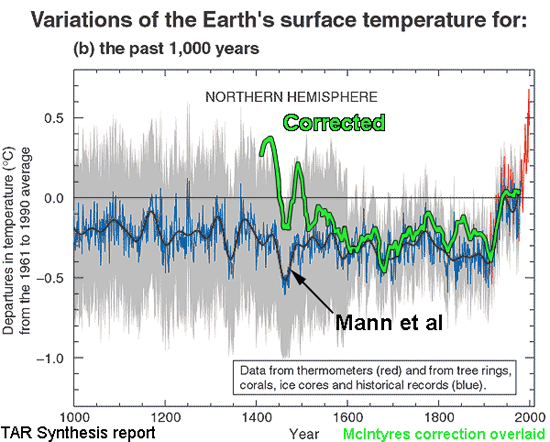
Fig. 3
For a more detailed analysis of the Mann hockey stick, see Energy & Environment, Vol. 18, No. 7, 8, 2007. There David Holland's 34-page analysis declares the Mann et al study “a sloppy, poorly documented paper riddled with simple mistakes, unjustified assumptions, collation errors and incorrect methodology. Data, for instance, reported to be from near Boston, Massachusetts actually came from Paris. Central England Temperature data was truncated eliminating its coldest period.” Holland cites other examples where data were selectively omitted that would have negated Mann's conclusions. Further, he asserts that Mann must have known what he was doing, had run calculations with some of the omitted factors and deliberately—not accidentally—omitted the information because it contradicted what he wanted to prove. In addition, Holland criticizes IPCC efforts to support the hockey stick with other invalid graphs that also failed to use all the available data. He states: “Such manipulation of data and graphical presentation might charitably be viewed as 'graphsmanship'; alternatively, it is fraudulent.”
Since carbon dioxide from burning fossil fuels cannot harm human health directly, the EPA alleges the health hazard is indirect, from global warming. This is why EPA has declared carbon dioxide to be a pollutant; otherwise it would have no legitimate authority for regulating it. But an array of studies over more than twenty years demonstrates that warm climate is beneficial while cold climate is detrimental to human health.
In 1998, Thomas Gale Moore's “Health and Amenity Effects of Global Warming” estimated a temperature increase of 2.5 degrees Celsius would cause a decrease of 40,000 deaths per year from respiratory and circulatory disease, based on U.S. Mortality Statistics.
In 1997, “Cold Exposure and Winter Mortality from Ischemic Heart Disease, Cerebrovascular Diseases, Respiratory Diseases and all Causes in Warm & Cold Regions of Europe” (Keatinge, Donaldson, et al) explained the mechanisms of serious illness from cold: hemoconcentration increases blood viscosity and accounts for half of all excess cold-related mortality. In 2000 “Heart Related Mortality in Warm and Cold Regions of Europe: Observational Study” examined mortality as a function of mean daily temperature in Athens, Greece; London, England; and Helsinki, Finland. These two studies provide the most comprehensive evidence that mortality decreases as temperature increases, over most of the current climate range of Europe. The data show U.S. mortality from cardiac, vascular, and respiratory disease in winter is seven times greater than in summer; in Europe, nine to ten times greater. Data from the 1997 study indicate an estimated 25,000 to 50,000 fewer deaths in the U.S. per year from a 1 degree C temperature rise.
In 2007 Deschenes and Moretti presented a comprehensive study of all-cause mortality as a function of the day of the year. Maximum mortality occurs in January, and the minimum is in the warmest months of July and August.
In 2008 the U.K. Department of Health released “Health Effects of Climate Change in the UK 2008”, an update of reports from 2001/2002. It showed that there was no increase in heat-related deaths 1971-2002 despite warmer summers. And cold-related mortality fell by more than a third in all regions.
So, there is no global warming. Since 1989 the U.S. alone has spent $79 billion on global warming, and tens of thousands of jobs have been created on an internationally organized climate racket that perverts the truth. It devours financial and human resources to justify a political ideology that is as phony as its scientific pronouncements. It is an ideology that demands an ever greater control over human activities by an ever expanding government under the dishonest claim of protecting human health—when human health would actually benefit from a warmer climate. And people's health would also benefit more if the funds and labor government spent on climate programs were instead spent by people themselves in a free market economy. It is wrong not only to claim human actions are causing global warming but to claim we can change the climate at all, because nature, not man, determines climate. What it all boils down to in the end is extending political control over people for the sake of extending control over people. Science doesn't matter. The truth doesn't matter. They have become merely useful terms to hide the deceit of politicians and activists in promoting their agenda.
Dr. E. Calvin Beisner attended the much-ballyhooed global climate conference in Copenhagen in mid-December 2009. His description of the experience is quite different from reports by the major news media in the U.S.
"We were a small group (about 30 or 40 of us) in the midst of a roiling sea of protesters (almost all on the 'other side'), probably twenty thousand or so, in downtown Copenhagen, waving signs, shouting slogans, etc. The biggest groups seemed to be the Communist Party (yes, their signs said that), the International Socialist Youth Movement, the Radical Climate Activists, and Greenpeace, and one of the most widespread slogans was 'System change! Not climate change!'—the meaning of which was, get rid of capitalism and usher in communism to save the world!...
"Well, if nothing else confirms that, the official delegates’ response to the tirade by Venezuelan President Hugo Chavez this morning does. Chavez, who exceeded his five-minute time allotment by 20 minutes, told the crowd that the process here was 'not democratic, it is not inclusive, but isn’t that the reality of our world, the world is really an imperial dictatorship . . . down with imperial dictatorships.' The crowd applauded vigorously.
"Then he said there was 'a silent and terrible ghost in the room'–capitalism. The crowd applauded even more vigorously.
"But when he concluded, 'our revolution seeks to help all people . . . . socialism, the other ghost that is probably wandering around this room, that’s the way to save the planet, capitalism is the road to hell . . . . Let’s fight against capitalism and make it obey us,' the crowd of official delegates—no doubt sober, unbiased, evenhanded, objective public servants all—gave him a standing ovation.
"And that—not science—is what’s driving the demand for a global climate treaty."
Why didn't the news media report the true nature of this global climate conference?

